
Instagram inspired books read and reviewed with an honest perspective

Title: Melting Faces in Cracked Mirror
Author: E.D. Small
Genre: Poetry
Poetry is oftentimes subjective, which is one reason I enjoy reading it every now and then. There are a number of Poets on Instagram one can follow and take advantage of reading their work. Some have full poetry compilations, one of which is E.D Small.
This book is filled with wonderfully connected words from Mr. Small. I enjoyed reading these in little bursts. I can’t read a book of poetry like a regular fiction book, which is why my journey with this one has been over the course of the last few months. The ebb and flow of Small’s poetry is a welcoming change to the continuous push to the end of a chapter in a fiction book. You slow down to read and connect, dream a little, contemplate and re-read because it is absolutely fitting to do so.
There is a rich old soul feel to Small’s works, warm with a soulful magnetism that pulls one in. I equate it to listening to a good old record with the voice of Donny Hathaway and sipping on a nice glass of Chianti. Mmmm. Nicely done!
Highly recommended to poetry readers!

Title: Dear Vicky
Genre: Horror
Author: Octavia Grant
I saw this quick read on IG and was intrigued by a comment, saying, Wow…I want more.
So…I wanted to give it a read.
Short and to the point, Andrew works at a grocery store where one of his primary functions is bagging groceries. One day, a beautiful woman walks in, purchases a few items and has a brief exchange with him during her transaction.
From there this tale goes from zero to ninety…quick.
Told from the POV of Andrew, the voice is almost childish. Like a teenager who doesn’t understand right or wrong. Grant takes us on a ride with Andrew’s behavior becoming more and more disturbing until we come to understand why.
I have totally mixed feelings about this story. Understanding that I was reading a horror story, blood and gore, deranged characters and circumstances existing outside of reality are all part of the genre. Grant delivered here.
I think my problem here was the character, his voice and the problem we find with him and the author’s choice to tell this story in this manner. Not all people with mental illness sound like a confused teen or pre-teen and that is what I felt here. I could be wrong, but I’m wondering how much research the author did to convey the voice of a mentally distraught person. The condition mentioned did not answer the motivation behind what some of what this character does, only part. Additionally, secondary characters are not very strong and some dialogue is used to explain matters to the reader, and not as organic dialogue.
I love well developed characters and when I read, I am looking for that. Dear Vicki just didn’t resonate with me. It felt like a decent writer had an idea of a B horror movie and just let the fingers do the creation of the most dreadful train derailment one could imagine. Now, reviews I read for this one speak a different story. Reading is oftentimes subjective. With that said, it would be great to hear your opinion on this one if you have read it.
I will read Grant again; I just didn’t jive with this story.
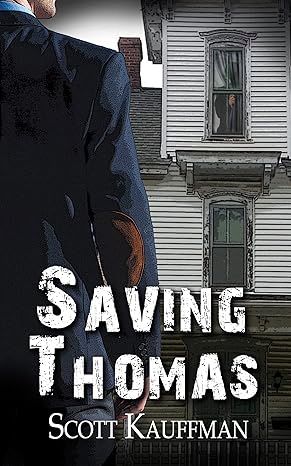
Title: Saving Thomas
Author: Scott Kauffman
Genre: Historical Fiction
Kauffman’s Saving Thomas takes the reader back to the sixties and seventies and introduces us to Jeremy, a writer/reporter for a small newspaper in a small town. The town has a resident with a secret, and who has decided to remain shut off from the world. When it is announced that the Queen of England nominates the town recluse for knighthood, gossip becomes a reality and Jeremy is moved to find out more behind the story, especially after the recluse declines the knighthood.
Kauffman uses an interesting point of view character to tell the story of another person’s background. It is fitting that Jeremy is a newspaper reporter, the perfect person to deliver the story. I found that by using this POV character, it forced the introduction of a number of different characters to effectively tell Thomas’s story, some using unreliable memories or even post-traumatic stress circumstances to steer from the truth. We as readers are moving through putting pieces together as the reporter would. Kauffman also uses Jeremy, the reporter as the main character or character that would surprisingly need to grow the most as the focal point, so Thomas’s story and Jeremy’s story in a way become intertwined. It just felt a little mottled to me with so many stories needing to come together.
Kauffman has a lovely style, and expertly crafted Jeremy’s voice. His characters are lively and were well done.
This book is not terribly long, but took me some time to get through, because of the historic elements and fact building that are heavily connected to the plot itself. If you enjoy reading historical fiction, especially World War II, this one is a nice choice, it addresses some circumstances that are not often spoken of such as small towns and the impact of the war in such regions.